


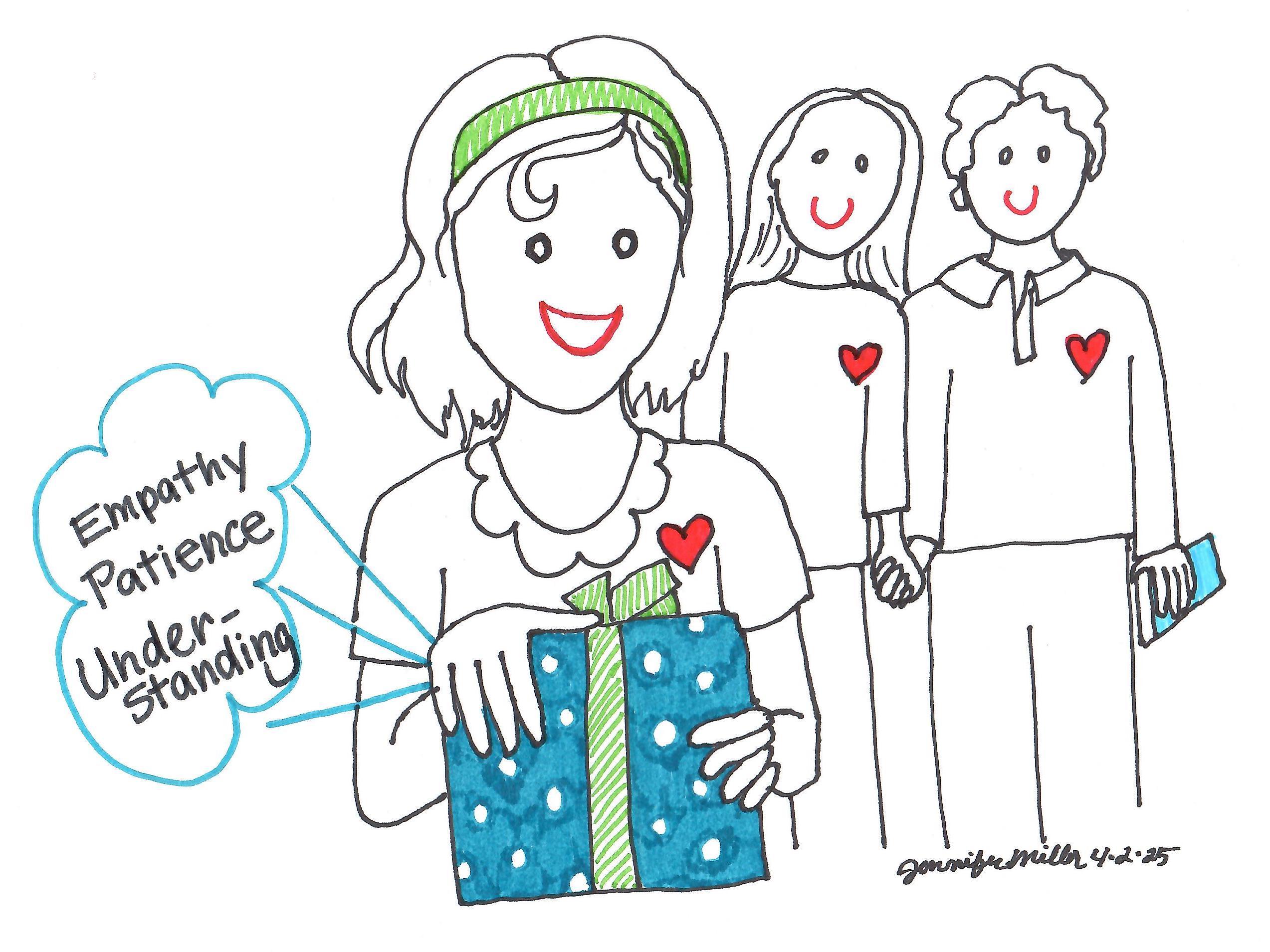
My son turns 18 today. I can hardly believe it. I’ve given him this gift for his birthday every year and though he may not recognize it, I know he’s benefitted tremendously. It’s helped me become a more patient, empathetic, and understanding Mom. Check out the ultimate birthday gift…
Why can’t he organize his time better? He knows he needs to study over time not cram it all into one night.
Why does she do her homework and then forget to turn it in?
Why does he want to hang out in the basement so much when he could be out with friends or doing something with us?
What is this sudden fascination with makeup? She’s far too young!
As parents, we get frustrated with our children’s and teen’s behavior and depending upon our parenting attitudes, make conclusions to answer these “why” questions. We know that the way in which we choose to parent brings together a combination of our own upbringing (our original parenting training), our worldview (is it a helpful world? Is it a harsh world?), how we understand and view how to motivate others to action, and how we believe we need to prepare our children today for their future. And in addition, we know that our children and teens view their lives from a widely different vantage than we do. So many of our challenges with our children and teens are related to their development. Our level of frustration can rise without understanding where their awareness level is and what they are focused on learning at each age and stage. How do we know our expectations are reasonable of them in their development? When parents have the opportunity to dream about what they need most in dealing with their children’s challenges, patience is one of the number one responses. So how can we gain patience?
We cannot remember our own authentic perspectives in those earlier stages of life to gain empathy. And even if we could, they would not be relevant since the context — the social and cultural environment in which our children are growing up — is far different than the context we grew up in. That context plays a significant role in how they are learning and growing. Researchers have examined parents’ ability to take the perspective of their child.1 Parents who could predict their children’s thinking and reasoning ability were far better able to match their thinking and advance it through their teaching efforts. Another study found that parents who could accurately identity their child’s thoughts and feelings in a conflict were better equipped to resolve the conflict with both child and adult feeling good about the outcome. And finally, yet another study found that parents who could understand their child’s mental states also were more able to promote a secure attachment, which we know is critical in our child’s developing sense of self and confidence later in life.
So what is the best birthday present we can give to our children? Yes, empathy, understanding, and perspective-taking. A child’s birthday is an ideal time to learn about their perspectives because of the change in age and stage. The steps to building empathy for our children’s perspectives are simple but require our time and focused attention. When we devote this time and attention, we’ll discover that we’ll extend our patience because we can see daily situations even frustrations from their perspective.
Let’s take a look at some simple ways we can give this valuable present to our children.
- Set an intention. You can do this on your own or if you are fortunate enough to have a partner in parenting, then it’s ideal to establish an intention together. Intention statements aim your focus in a particular direction. Write down your intention and post it in a place that will help remind you (instead a kitchen cabinet?). “We are going to take steps to observe and learn about our child’s perspectives at their age/stage.” You are far more likely to achieve any goals you set if you create an intention.
- Read! If you have fifteen minutes, read these age-specific summaries from the American Academic of Pediatrics at healthychildren.org. They review what your child is learning physically, linguistically, socially, cognitively, and emotionally, all of which are important to understand. If you would like a book or two on the topic to get at the ready, here are a few we recommend:
- Ages and Stages; A Parent’s Guide to Normal Childhood Development by Charles E. Schaefer, PhD. and Theresa Foy DiGeronimo (Birth to Age 10)
- Healthy Development and Well-Child Support Chart by the American Academy of Pediatrics (Birth through Adolescence)
- The Whole-Brain Child; 12 Revolutionary Strategies to Nurture your Child’s Developing Mind by Daniel J. Siegel, M.D. and Tina Payne Bryson, PhD. - Take a particular look at the whole brain strategies for supporting development by age and stage on pgs. 154-168.
- Confident Parents, Confident Kids - We can’t leave this out! This book offers an age by stage guide (by age range) of children’s and teen’s social and emotional development and ways we, as parents, can be supportive.
3. Observe and listen. Now that you have some research-backed information on your child’s specific developmental milestones they are working on, observe them. What do you notice that aligns with what you’ve read? How does it show up in your daily life? Listen to their thoughts and feelings. How does it reflect the awareness level you’ve come to understand they likely have at this age/stage? How are they seeing their world? Consider the challenges you’ve had with them. How does their perspective shape or influence these challenges? How can you view them through their age/stage lens?
4. Journal and reflect. Write down your observations. Include quotes and notes on feelings you observe and the situations they are in that helped create those feelings. These may become precious to you someday as you save them and look back. But for today, they will begin to formulate a picture of empathy and understanding.
5. Share. Share your observations with all family members. Invite their insights. Your child is never too young to learn about their own process of development. By the way, perhaps this may generate some curiosity in your own adult development. We never stop developing even though in our emerging adult years after school has ended, the world attempts to convince us we are finished with our learning and awareness raising. If your curiosity is peaked, check out the Harvard Study of Adult Development.
6. Ritualize. Make this an annual event. Allow your child’s birthday to remind you that it’s also a time to learn about where they are in their development. Go through these simple stages again and feel more prepared to meet any new challenges with a strong dose of empathy and understanding!
Imagine how your life might have been altered had your parents done this for you at each birthday milestone. Your understanding of your child’s perspectives will help them feel a sense of safety, trust and value. And in your role as a parent, you will begin to feel a greater sense of competence as you meet challenges feeling informed about where your child’s is in their learning and growth. Mark your calendar now to give your child or teen the best birthday present you can possibly give!
Happy Birthday to E today who was the inspiration for this blog and work in the first place!
Reference:
Grusec, J.E. (2006). Parents’ Attitudes and Beliefs: Their Impact on Children’s Development. Encyclopedia on Early Childhood Development. Toronto, CA: University of Toronto.
Adapted from originally published April 3, 2025.
